On a sunny afternoon in the year 30,456 BC, Bartholomew Browne was taking a constitutional along the gravel foreshore beneath Tower Hill.
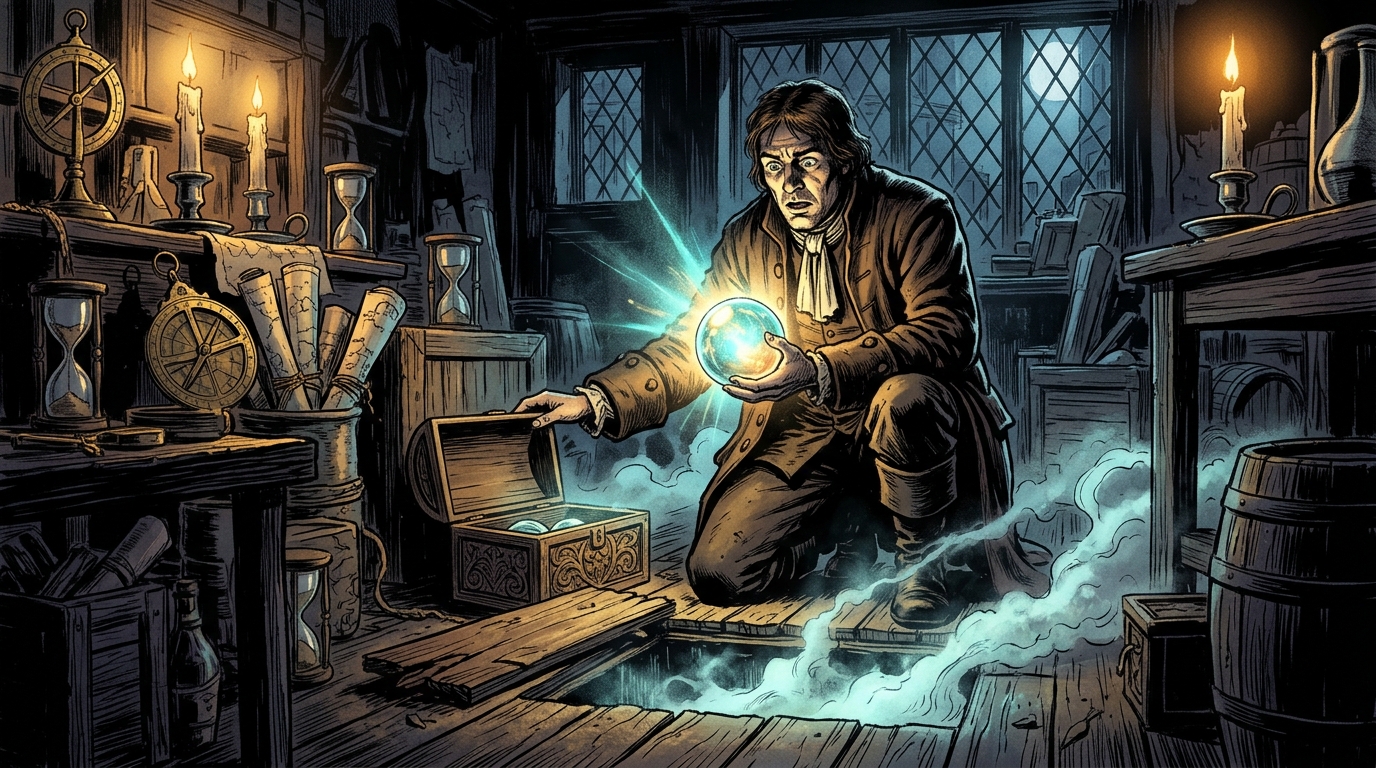
His brown broadcloth coat had shrunk lamentably after its immersion in the Thames, splitting up the back seam so that he had been obliged to accept the loan of a scraped reindeer pelt from his hosts, which he wore draped over his shoulders like an alderman’s tippet. Behind him walked two stocky Neanderthal youths carrying flint-tipped spears, who appeared to have appointed themselves combination valets and bodyguards to ensure the strange pale gentleman did not wander into the path of another red-furred elephant.
‘Où est la diligence pour Calais?’ Bartholomew inquired loudly, gesturing with a peeled willow switch which he used as a walking-cane. ‘Le bateau? La taverne? Good heavens, has nobody in this province heard of the Dover packet?’
His two companions grunted amiably, scratched their ribs, and pointed at a flock of cranes wheeling over the Southwark marshes.
Bartholomew sighed. The French provinces were even more backward than the London pamphlets claimed, though he was forced to admit the venison roasted over an open pit the previous evening had been remarkably tender. Adjusting his spectacles, he continued his stroll along the bank, determined to maintain the hours of a Christian tradesman even among Papists who neglected to build roads.
Thirty-two thousand years further up the river’s history, Isaac Peckham was having a far worse time of it.
After losing sight of Raahi Shah in the tumultuous Restoration crowds of Cheapside on the twenty-ninth of May 1660, Peck had ducked into the shadowed porch of St Mary-le-Bow to examine the H6 undisturbed.
During his tavern brawl with the Indian fisherman, the middle brass wheel on the flank of the watch had been knocked forward six divisions —carrying him six hundred years from 1066 to 1660. He was now only a hundred and sixteen years shy of his own century.
Hands trembling with excitement, Peck counted the tiny engraved graduations along the middle and lower wheels. If one major division on the middle dial represented a century, then nudging the lower wheel forward by a single mark and six tenths ought to land him squarely in the spring of 1776, before Doctor Maskelyne’s carriage had even reached London Bridge.
Carefully, using the point of his thumbnail, Peck clicked the lower wheel forward—unaware that the grit of Senlac Hill and the blow against the tavern flagstones had jammed the tens-pinion by a single tooth.
Instead of setting a course for 1776, he had dialled forward a mere six years and three months.
Holding his breath in the church porch, Peck twisted the glass bulb at the crown of the watch.
The familiar blue-white radiance flashed around him; the cheering crowds and pealing bells of 1660 vanished into a roaring tunnel of wind; and Peck was pitched forward onto rough-hewn pine floorboards that knocked the breath clean out of his chest.
He rolled onto his side, coughing violently.
The air in this new room was stiflingly hot and dry—thick with the smell of parched deal timber, rendered lard, wood-ash, and the sweet, yeasty tang of rising bread dough.
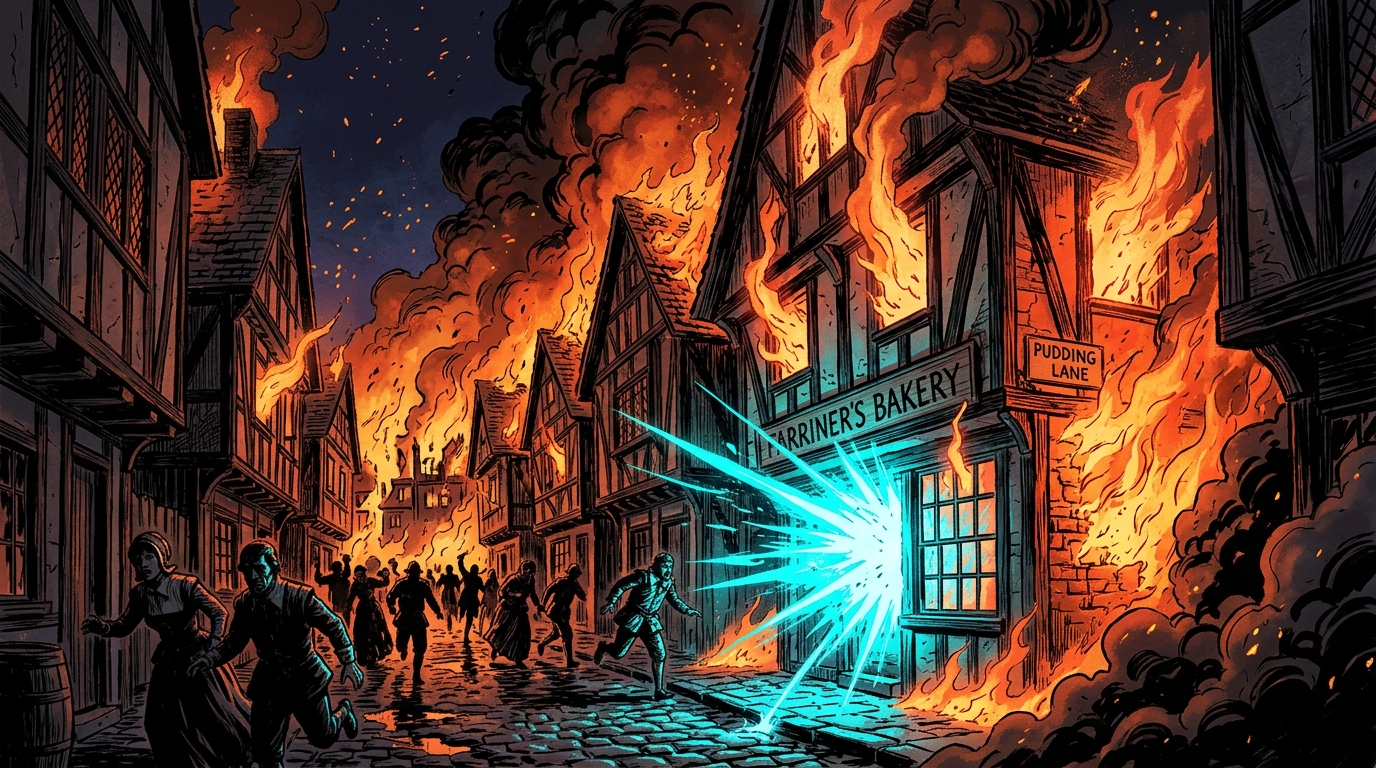
It was shortly after midnight on the second of September 1666, and Peck was lying in the low-raftered bakehouse and fuel-loft of Thomas Farriner’s bakery in Pudding Lane, three hundred yards north of London Bridge.
‘Who goes there?’ a hoarse voice rasped from the darkness at the top of the narrow stair. ‘Thieves, is it?’
Peck scrambled backward on his heels, his boots scraping against dry bundles of brushwood stacked beside a massive brick oven. He clutched the gold H6 tightly against his waistcoat; its glass chamber was still pulsing with a dying, violet-blue afterglow that cast strange shadows across the flour-sacks.
Thomas Farriner, the King’s baker, stepped onto the landing in his linen nightshirt and cap, holding a flickering tallow candle aloft in an iron holder.
In the jump from sleep, Farriner did not see a terrified thirteen-year-old apprentice; he saw a soot-smeared figure materialising out of a shimmer of blue witch-fire right beside his ovens. The baker’s eyes bulged in their sockets, and his hand shook so violently that hot tallow splashed across his knuckles.
‘The hearth…’ Farriner stammered, his gaze darting wildly from the glowing watch in Peck’s fist to the iron door of the great brick oven in the corner. ‘I raked the embers at ten! I swore to my maid I raked them!’
Peck glanced toward the oven. Through a hairline crack beneath the ill- fitting iron door, a single live coal—missed when the baker had drawn the ashes—was glowing cherry-red in the draught. Worse still, piled directly against the scorching brickwork of the flue stood a dozen dry willow faggots and a deep scattering of floor-rushes brittle from two months of summer drought.
‘Your brushwood’s too near the flue, mister!’ Peck cried out, his voice cracking as a curl of grey smoke began to rise from the rushes. ‘It’s catching!’
‘Avaunt, foul fiend!’ Farriner shrieked, crossing himself in blind, pious terror at the boy who had conjured smoke from his hearth. ‘Be gone, devil!’
With all his strength, the terrified baker hurled his lit tallow candle straight at Peck’s head.
Peck ducked; the iron candlestick missed his ear by an inch, clattered against the brick chimney-breast, and bounced squarely into the dry rushes and willow faggots heaped beside the oven.
It did not merely catch; it exploded into a sheet of greedy orange flame.
Parched by the hottest, driest summer in living memory, the pitch- soaked pine kindling roared alight in three seconds flat, sending tongues of fire licking up the tarred timber wall toward the rafters.
‘Wait—no!’ Peck shouted, horrified as the realization hit him like a physical blow. Pudding Lane. A baker’s house near the bridge. September. Every child in London knew how the Great Fire of 1666 had begun. If he had not tumbled out of the air into this loft, Farriner would never have thrown the candle!
Desperate to undo what his arrival had sparked, Peck lunged across the scorching boards toward a wooden bucket of slops standing beside the kneading-trough.
Before his fingers could reach the rope handle, the H6 in his left hand surged.
Fed by the sudden radiant heat of the burning bakehouse—or triggered by the damaged pinion slipping free inside the case—the watch became hot as a live coal against his palm. The crystal inside the glass bulb spun at a blinding speed, its blue-white mist turning a fierce, bruised purple as a high-pitched whine drowned out the crackle of the flames.
Above him, the resin in the ancient oak rafters began to boil and spit. From the stair-head behind the wall of black smoke, Peck heard Farriner screaming to his daughter to climb out onto the roof-leads through the garret window.
‘Not again—please, not again!’ Peck sobbed, trying in vain to jam the spinning glass bulb with his thumb as the floor beneath his boots began to buckle in a shower of sparks.
The crystal reached its crescendo. As the blazing rafters of Pudding Lane gave a groan and collapsed inward, the bakery vanished in a blinding sphere of light—yanking Isaac Peckham out of the seventeenth century and leaving behind a spark that would devour thirteen thousand houses, eighty-seven parish churches, and the medieval heart of London.