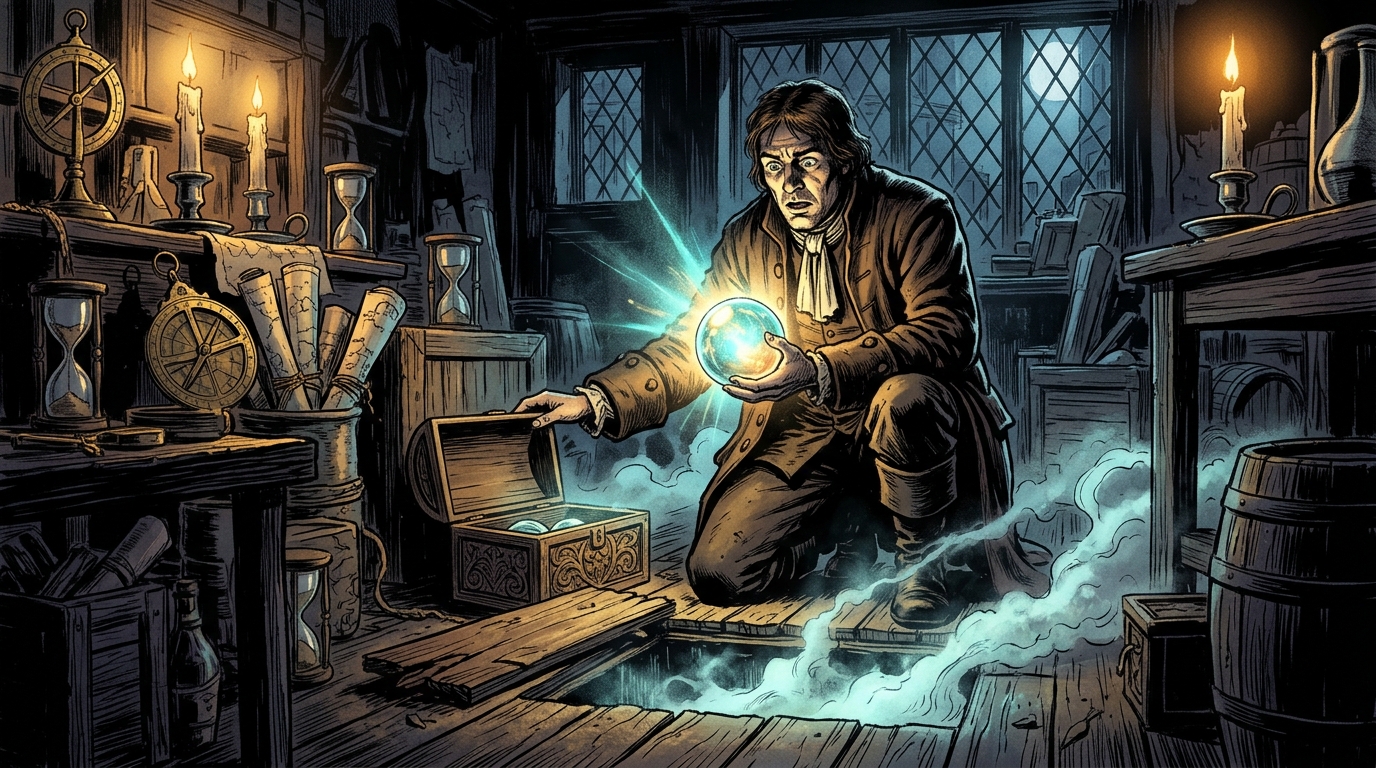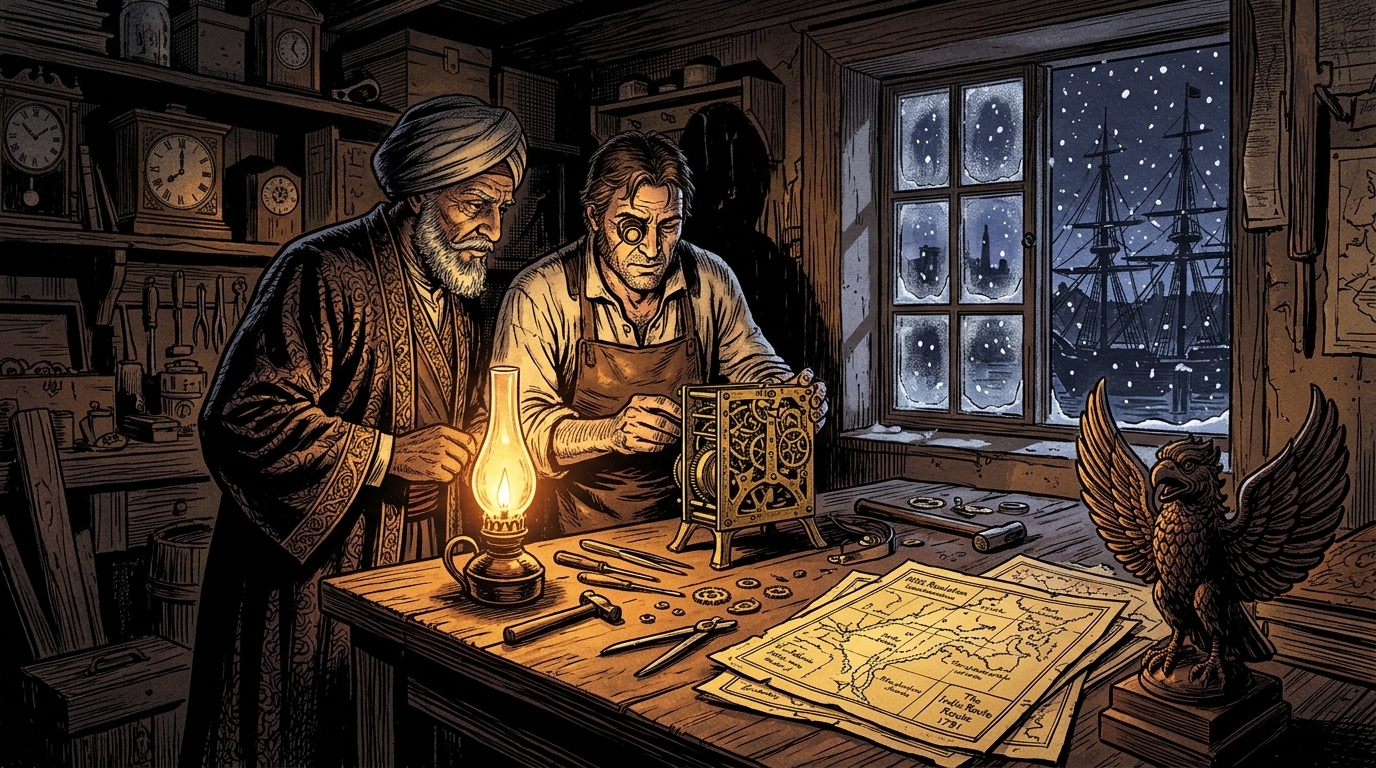
Two hundred and fifty years before the containment bell shattered beneath Athens, the back parlour of a narrow watch-shop near the Deptford docks smelled of old parchment, boiled tea, and the sharp, metallic tang of ozone.
It was a bitter night in the winter of 1792, and London was locked in a hard frost that turned the leaded window-panes into sheets of opaque silver. Yet for Anup Shah, sitting wrapped in a Paisley shawl beside the coal brazier, the decades had long since blurred into a single continuous vigil of ticking clocks and lengthening shadows.
He was one hundred and twenty-one years old now, his skin a roadmap of deep brown creases tracing a journey that had begun along the red- dirt tracks of Malabar and ended in the grey river-fogs of the Thames.
Across the workbench from him sat Samuel Hoy—no longer the brisk middle-aged merchant who had dined aboard Anup’s ship eighteen years before and foolishly carried the tale of Red Lion Square to Doctor Maskelyne, but a chastened, grey-haired man who had spent those eighteen years trying to atone for his loose tongue. Between them on the green baize cloth sat the duplicate gold timepiece—recovered from Greenwich after Nevil Maskelyne’s breakdown—its glass chamber suddenly humming in sympathy with a storm that had just erupted two centuries in the future.
‘You still think this is merely an engine of brass and wheels, do you not, Samuel?’ Anup rasped, his voice like dry autumn leaves skittering across stone as he gestured with a trembling finger toward the glowing crystal at the crown of the watch. ‘A clever piece of horology for the gentlemen of the Royal Society to quarrel over?’
‘It is a terrifying thing, Master Anup,’ Hoy whispered, his breath clouding in the cold room as he stared at the blue-white mist swirling faster and faster inside the glass bulb. ‘Doctor Maskelyne swore before he locked it away that it opened the very gates of Perdition.’
Anup let out a low, rattling cough that might have been a laugh. ‘No, my friend. My father, Raahi… he understood its true nature long before John Harrison ever caged it inside English gold. When I told you the fable of the Fisherman and the Eagle aboard my ship in seventy- four, I gave you only the children’s version. I did not tell you the ending of the Katha—the ancient song of the Garuda-Vat.’
Anup leaned forward, the shadows of the tiny shop deepening around his chair as the hum of the watch vibrated in their teeth.
‘In the time before the roads of the world were paved, before the European ships came to Calicut with their cannon and their compasses,’ Anup murmured, ‘our people sang that the Great Eagle did not fly for his own glory. He flew to bear the weight of the sun across the heavens. Yet once in every great cycle of the world, the Eagle’s wings grow heavy. Not with rain, Samuel, but with the salt of human sorrow—the salt of every war we wage, every betrayal we speak, every child cast out into the smoke. That salt crusts upon his feathers until the Great Bird can no longer hold the sky, and he falls broken into the red mud of the mortal shore.’
‘And what becomes of him when he falls?’ Hoy asked softly, unable to tear his eyes from the pulsing gold case.
‘He waits,’ Anup whispered. ‘My father found that broken eagle on the beach in 13 AD and tried to warm it beneath his coat. When the bird died in the sea-cave, my father found the crystal beside the Portuguese sailor’s bones and thought its fire was a gift—or a curse—to be used. And the boy from Red Lion Square, who grew up in a distant age to call himself the Dragon, took that fallen crystal and built a golden cage around it, forcing history to repeat its cruellest hours over and over so that he might live as a god.’
Anup reached across the workbench and gripped Hoy’s wrist with fingers cold as iron bands.
‘Do you understand at last, Samuel? Right now, at the far edge of time, the Dragon has forced the two stones together. The storm is tearing through every hand that ever touched the watch. My father gave his youth in 13 AD to begin the circle, and I have lived the slow way across more than a century of winters to guard this end of the chain. Now the watch is calling for the circle to close.’ With both hands, the centenarian lifted the vibrating gold timepiece from the baize and pressed it firmly into Samuel Hoy’s palms. The crystal inside the glass bulb was singing now—a frantic, high-pitched throb like the heartbeat of a dying bird.
‘Do not let the Dragon persuade you that his loop is necessary,’ Anup whispered, his milky eyes shining with sudden, fierce hope. ‘The true ending of the Katha says that the Eagle does not fall so that men may harness its lightning to rule the world. It falls because it is exhausted, and it waits for three souls who have carried its sorrow to have the courage to let the fire go out.’
As Anup spoke the final word, the blue-white radiance inside the glass bulb burst the bounds of the watch-case, flooding the Deptford shop with a blinding light that smelled of monsoon salt and ancient dust.
Hoy cried out as the floorboards vanished beneath his boots, pulling him straight into the eye of the storm—while old Anup Shah leaned back in his wooden chair in the sudden, blessed silence, smiling into the dark now that his century of watch-keeping was finally done.