Seventeen days after John Harrison’s death, his son William Harrison— a stout, practical man of forty-eight whose heart belonged more to country committee-rooms than to the bench—followed Peck up the stairs into the silent study.
‘What in heaven’s name am I to do with all this, Peck?’ William sighed, gesturing helplessly at the forests of brass pendulums, gridiron bars, and half-finished movements covering every surface. ‘It would take a lifetime merely to catalogue the springs.’
He turned a kindly, tired eye upon the boy. ‘You served my father faithfully at the last, Isaac. I shall see to it that your wages are paid in full, and if there is any tool or model in this room that you wish to keep to help you continue in the trade, I should be glad for you to take it.’
Peck’s pulse quickened. There was only one thing in the house he wanted—the watch he had seen glowing in his master’s burned fist at Christmas—yet despite searching every drawer since the funeral, he had not found a trace of it.
‘Thank you, sir,’ Peck said carefully. ‘If you do not mind, sir, there are several escapements your father left unfinished on the bench, and I should welcome the chance to complete my work on them before I go.’
‘Take your time, lad,’ William said, reaching for his hat and riding gloves. ‘I am returning to the country tomorrow morning. I shall be back in town next week, by which time I will have met with the solicitors to arrange the sale of the house and its effects. Lock up well behind you.’
Minutes later, the heavy street door closed, leaving Peck entirely alone in the tall, creaking house.
‘Where is it?’ Peck whispered to the empty study, running his fingers along the underside of the mahogany desk. ‘Where did you hide it, Master?’
He searched until dusk without success. Growing cold and dispirited as night settled over Red Lion Square, Peck built up a roaring fire in the study grate, drew his master’s armchair close to the fender, and—feeling rather bold in his solitude—uncorked a bottle of his master’s good Bordeaux. Before the longcase clock had struck eleven, the warmth of the coals and the unfamiliar wine had lulled him into a deep sleep.
It was just after three o’clock in the morning when the first sound woke him.
It began as a faint, metallic scraping from the rear courtyard at the back of the house, followed seconds later by a muffled thud, the splintering of dry timber, and a heavy crash.
Peck was on his feet in an instant, the wine cobwebs vanishing from his head. Pressing his ear against the oak panel of the study door, he held his breath and listened.
Low, gruff voices were muttering down in the back parlour. Heavy boots crossed the flagstones of the lower hall. Whoever had broken in was moving systematically from room to room, opening cupboards and overturning furniture as though searching for something specific. Now the scuff of boots and hoarse whispers could be heard directly at the foot of the main staircase.
Then—silence.
For a full minute not a board creaked. Had they given up and left?
Glancing over his shoulder, Peck realised with a lurch of dread that the oil lamp burning on the workbench was casting a bright yellow ribbon beneath the study door out onto the dark landing. Moving on tiptoe, he crept across the carpet and reached up to turn down the wick.
Panic, cold and sudden, gripped him. He was thirteen years old, slight of build, and utterly unused to housebreakers or violence. Perhaps if he called out and showed himself compliant, they would take whatever silver they wanted and spare his skin. ‘Hello?’ Peck called out, his voice cracking in the stillness. ‘Hello—who’s there?’
The words had barely left his lips when the study door was kicked open with a crash that split the lock-plate.
A massive, muscled arm lunged out of the gloom and clamped an iron hand around Peck’s windpipe, lifting him onto his toes and slamming his back against the bookcase. Two men filled the doorway, both wearing heavy military greatcoats over scarlet uniform tunics, with dark kerchiefs tied across the lower halves of their faces.
While the brute holding Peck pinned him to the shelves, the second intruder—a tall, lean man whose parted cloak revealed the chevrons of an East India Company corporal—strode across the room and turned up the lamp.
In the sudden flare of light, Peck saw that the man throttling him had a livid white scar running from beneath his left eye down into the folds of his kerchief.
Then, from the shadow of the landing behind his two henchmen, a third figure stepped into the study.
Peck recognised him at once from the single occasion they had met the previous summer—an evening when Peck had been curtly dismissed to the kitchen while angry voices thundered upstairs, ending with the visitor calling John Harrison a blasphemer before slamming the street door.
It was the Reverend Doctor Nevil Maskelyne.
Bundled in a dark velvet riding coat, the Astronomer Royal stood in the centre of the carpet, his heavy, jowled face gleaming in the lamplight, his small, calculating eyes sweeping the room with a stare that turned Peck’s blood to ice.
‘Start there, Corporal Brent,’ Maskelyne said, pointing a thick, pudgy finger toward the high cabinet beside the hearth.
While the scarred private kept his fist knotted round Peck’s collar, Corporal Brent moved swiftly through the study, wrenching open drawers and sweeping ledgers onto the floor. Suddenly Maskelyne barked, ‘Stop!’
Brent froze, holding a small mahogany case he had pulled from behind a row of astronomical almanacs. He held it out toward his master.
‘Open it,’ Maskelyne commanded through gritted teeth. ‘Quickly, man —hurry!’
Brent’s fingers found the brass catch and lifted the hinged lid. The interior of the box was lined with padded crimson velvet, hollowed out to cradle something heavy and delicate. Holding his breath, the corporal extended the open box at arm’s length so Doctor Maskelyne might inspect the prize.
For a heartbeat, the room was utterly still save for the Doctor’s heavy, eager breathing and the steady tick, tock, tick, tock of the longcase clock marking twenty minutes past three.
What happened next unfolded so swiftly that none of the four could ever afterwards untangle the sequence.
Without warning, a resinous oak log that had burned through in the grate collapsed and rolled straight out of the hearth, bouncing onto the floorboards in a blinding shower of orange sparks and choking smoke.
The scarred soldier flinched instinctively, turning his face from the embers and slackening his grip on Peck’s throat for a fraction of a second.
It was all the boy needed.
Twisting sideways in blind terror, Peck wrenched himself free and stumbled headlong into Corporal Brent’s outstretched arm. The crimson-lined box flew from the soldier’s grasp, somersaulting into the air and spilling its contents—a large, heavy gold pocket watch crowned with a glass bulb.
Peck’s hand shot out by pure reflex, snatching the watch in mid-air an inch before it struck the floor. Tumbling to his knees at Doctor Maskelyne’s buckled shoes, Peck ducked straight between the portly clergyman’s legs before the man could bend to seize him, scrambled up onto the landing, and threw himself down the dark staircase four steps at a time.
‘After him!’ Maskelyne roared from above. ‘Do not let him reach the street!’
Hitting the ground-floor hallway in pitch darkness, Peck spun round in confusion and bolted not toward the front door, but straight down the back passage into the kitchen.
Only as he slammed the heavy oak kitchen door behind him did he realise his blunder. The outer courtyard door had been bolted from the inside by the intruders after they entered, and the key was gone. Worse still, the basement kitchen had no windows large enough for a cat, let alone a boy. He was in a stone trap.
Heavy boots thundered down the stairs above. Peck began to shake violently; he had seen the look in Maskelyne’s eyes and knew with certainty that if those two soldiers laid hands on him again, they would snap his neck and drop him in the Thames.
Throwing his weight against the tall pine dresser beside the pantry, Peck shoved with every ounce of strength in his spare frame until the legs screeched across the quarry tiles and jammed hard against the kitchen door.
Almost immediately, the wood shuddered as four hundred pounds of muscle hurled itself against the other side. Stoneware plates cascaded from the dresser shelves and smashed around Peck’s ankles. Desperate for another ten seconds of life, Peck seized the edge of the massive oak scrubbing-table in the centre of the room, tipped it onto its side, and wedged its heavy frame between the dresser and the brick chimney- breast.
He had seconds before they splintered the lot.
Backing away until his spine hit the cold rear wall of the kitchen, Peck slid down onto the tiles and looked for the first time at the object clutched in his trembling hand.
The dial read twenty-three minutes past three. Even in the faint glow of the hallway tallow seeping through the cracks, he could see that it was the finest piece of horology his master had ever wrought—the secret H6. Three knurled brass wheels protruded from the side of the heavy gold case, and fastened to the top where the pendant bow should have been sat the thick glass bulb housing the multifaceted crystal.
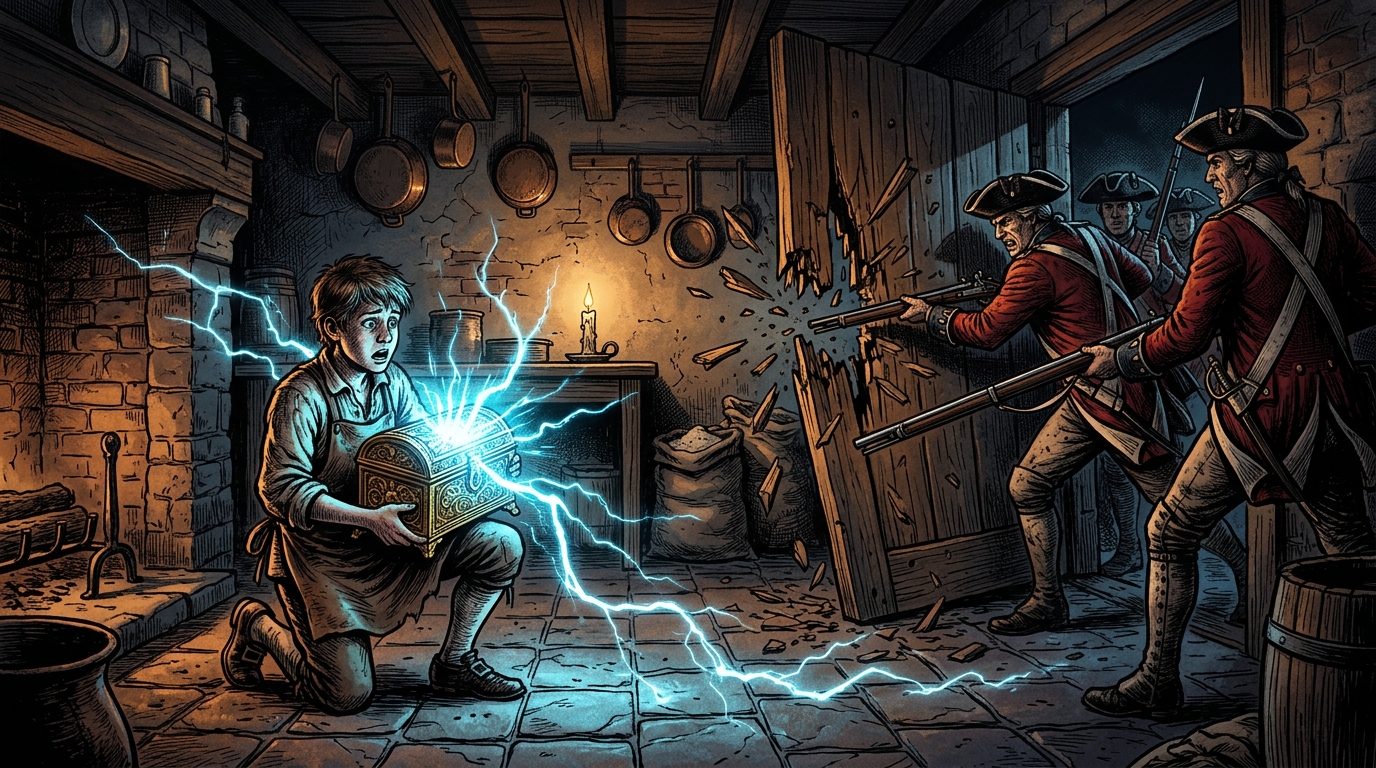
With a deafening crack, the oak table slewed sideways across the tiles. The pine dresser tilted, groaned, and crashed face-down onto the floor as the kitchen door burst inward.
Doctor Maskelyne and his two henchmen stood framed in the doorway, chests heaving. Corporal Brent took a step forward, drawing a heavy brass-butted pistol from his belt, when Maskelyne raised a hand to halt him.
‘Give me the watch now, boy,’ Maskelyne said, his voice dripping with false reasonableness. ‘Hand it over quietly, and you have my word as a clergyman we shall leave you in peace.’
Cornered like a rat against the bricks, Peck looked down at the glass bulb at the crown of the watch. Without knowing why—remembering only the blinding light under the study door at Christmas—his thumb and forefinger gripped the glass chamber and twisted it hard to the right.
At once, the crystal inside began to turn.
At first it revolved slowly, casting sharp blue sparks across Peck’s knuckles; then it spun faster and faster until a high, singing vibration filled the kitchen.
‘Get him!’ Maskelyne shrieked, his face contorting. ‘Get him now!’
Brent and Cobb lunged across the shattered crockery.
Before their fingers could touch his collar, a blinding white radiance exploded from the watch, swallowing the kitchen, the upturned table, and the charging men. Peck felt the cold tiles vanish beneath him as though he had been pitched headfirst down a bottomless well. He fell through roaring, icy space for what felt like an age—and then hit damp turf with a bone-jarring thud.
Blinking at a grey, smoke-streaked sky, Peck found himself lying in a muddy field surrounded by hundreds of bearded men clad in chainmail hauberks and conical iron helmets, all shouting in a tongue he could barely comprehend. Perhaps he was dreaming; perhaps the soldiers had killed him after all. Whatever the truth, he was no longer in John Harrison’s kitchen.
At thirty-five minutes past three on the morning of the tenth of April 1776, Doctor Nevil Maskelyne, Corporal Charles Brent, and Private Edward Cobb stood in the wreckage of the Red Lion Square kitchen, rubbing their dazzled eyes.
Maskelyne stared in rigid silence at the empty corner by the rear wall where, ten seconds earlier, a terrified thirteen-year-old boy had been sitting. The boy—and the watch—were gone.
Private Cobb was the first to find his voice, crossing himself with a trembling hand. ‘Sir… I dunno about this, sir. I just saw that lad vanish into thin air.’
‘You will mind your tongue, Cobb!’ Maskelyne snarled, wheeling on him with such fury that spittle flew from his lips. ‘You will mind it, or by God I shall have you clapped back in irons and shipped to the deepest, hottest fever-hole in Bengal!’
Cobb flinched and took a hasty step backward, touching his scarred cheek. He loathed this fat, pompous parson with every fibre of his twenty-year-old body, yet he knew that Maskelyne held his life in the palm of his hand.
Six months earlier, Cobb had been a private soldier of the garrison at the Tower of London. Left on night sentry duty beside the Traitors’ Gate with a flask of cheap gin in his coat, he had been discovered dead drunk and fast asleep at his post by the sergeant of the watch. A court- martial the following week had found him guilty of gross dereliction under arms and sentenced him to hang by the neck at dawn. Only his weeping mother’s frantic petition to the Reverend Doctor Maskelyne— for whom she laundered linen at Greenwich—and the Astronomer Royal’s quiet word with the Secretary at War had commuted the rope on the very eve of execution. Since that morning, Edward Cobb had belonged body and soul to the Royal Observatory as Maskelyne’s personal dogsbody and muscle. ‘Corporal Brent,’ Maskelyne snapped, smoothing his rumpled velvet waistcoat. ‘Take Cobb upstairs and make sure that fire in the study is properly doused. Put the books and drawers back as you found them. I want nothing left to arouse William Harrison’s suspicions.’
As Brent and Cobb skulked out of the kitchen and climbed the stairs, Maskelyne remained motionless in the hallway, rubbing his double chin.
How on God’s earth had the brat disappeared? Had Harrison truly harnessed the Indian stone’s power to step outside creation?
Five minutes later, when Maskelyne mounted the stairs to inspect their handiwork, the study looked entirely undisturbed; the spilled sparks had been swept into the hearth and the crimson velvet box replaced on the shelf.
‘Are we finished here, sir?’ Brent asked quietly.
‘Not quite, Corporal,’ Maskelyne murmured, his small eyes narrowing. ‘I have a feeling we are missing something. I know John Harrison’s mind. A mechanic as obsessive as he would never stake forty years of labour on a single prototype. When he built H4 for the Admiralty, he had K1 made alongside it. He would have made a duplicate. You two search the bedchambers and the garret from rafters to skirting-boards. I shall take the ground floor.’
Returning alone down the dark stairs, Maskelyne paused at the threshold of the kitchen. Was it the work of the Devil? he wondered, staring at the bare bricks where Peck had vanished.
Stepping over the smashed earthenware, Maskelyne shoved the overturned oak table aside and walked to the centre of the room. Set into the red quarry tiles directly beneath where the table had stood was a heavy cast-iron drainage grating.
Bending down, Maskelyne hooked the fingers of both hands through the iron bars and braced his back to heave with all his might.
He needn’t have exerted himself. At the very first tug, the unfastened grating came flying straight out of its stone seating, pitching the portly Astronomer Royal flat on his backside against the rear wall with a loud oomph. That was altogether too easy, Maskelyne thought, wincing as he rubbed his bruised tailbone. Someone had lifted this grate very recently.
Scrambling onto his hands and knees across the tiles, Maskelyne leaned over the dark mouth of the drain and peered inside. About six inches below the rim, a square recess had been chiselled out of the damp brickwork. At first glance the cavity looked empty, but when Maskelyne rolled his coat sleeve up to the elbow and groped blindly along the rear ledge, his fingers brushed against greased leather.
Drawing the object out, he rose and laid it upon the corner of the table. It was a heavy oilskin pouch, laced tightly shut through brass eyelets with a waterproof leather thong.
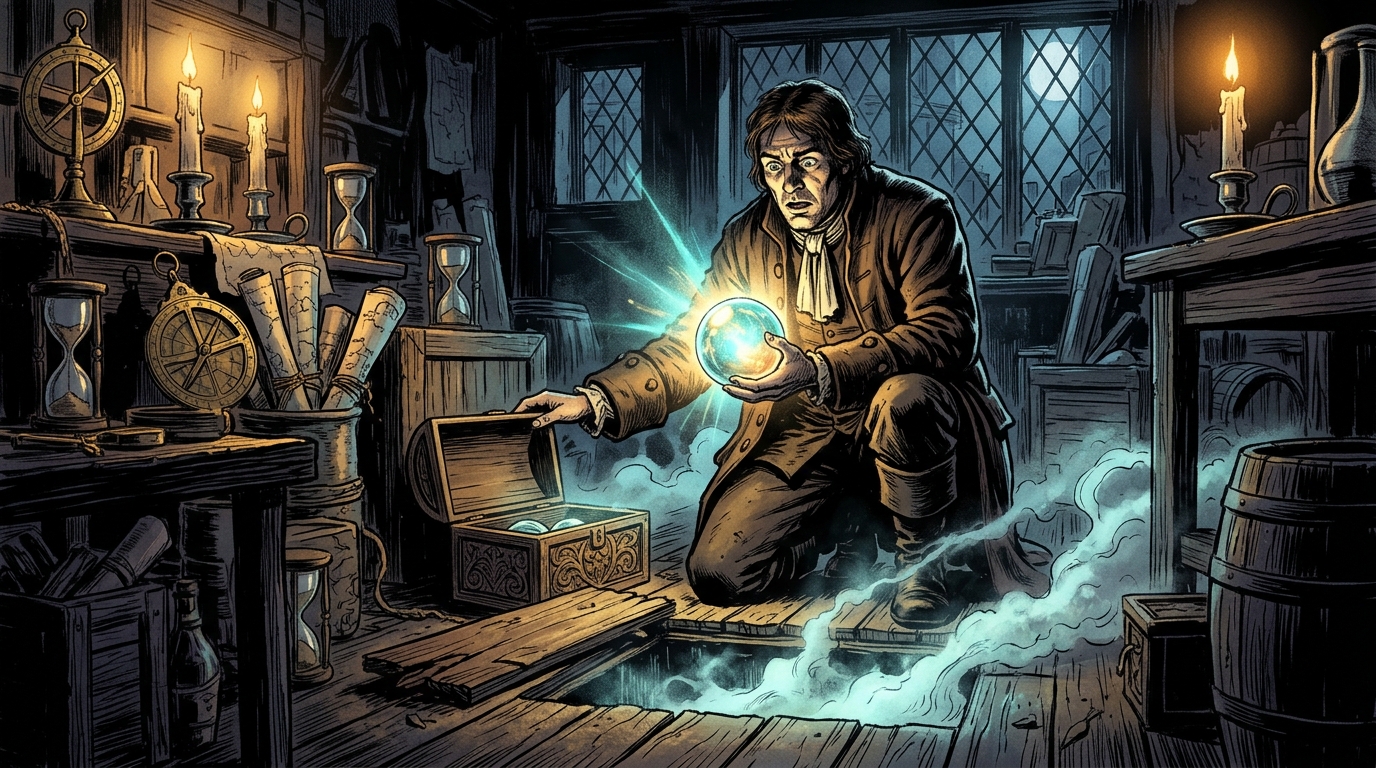
With hands that shook violently, Nevil Maskelyne untied the thong, parted the folds of oiled leather, and lifted out a gleaming gold pocket watch—identical in every proportion to the one Peck had snatched upstairs, crowned with a blown-glass bulb housing a flawless crystal the size of a walnut.
‘Magnificent…’ Maskelyne breathed, holding the cold gold to the lamplight. ‘It is—’
‘Sir?’
Maskelyne whipped his coat tail over the oilskin bag as Corporal Brent stepped into the kitchen doorway.
‘We’ve turned out every room upstairs, sir, and found nothing at all. Will that be all for tonight?’
Maskelyne slipped the heavy watch deep into his inner pocket, his fingers closing greedily around the glass chamber.
‘Yes, Corporal. That will be all for now,’ Maskelyne said, a slow, triumphant smile spreading across his jowls. ‘Bring the carriage round to the corner of the square. We are returning to Greenwich.’
Ten minutes later, as the first grey light of dawn touched the chimneys of Holborn, the Astronomer Royal’s coach rattled south toward London Bridge, crossing the river into Southwark to follow the rutted Deptford road back to Greenwich Hill. Inside the swaying cabin, Nevil Maskelyne slept soundly with one hand buried in his coat pocket, while up on the driver’s box Brent and Cobb hunched against the morning mist, exhausted and silent after the night’s work.