Two days after the slaughter on Senlac Hill, on the sixteenth of October 1066, Peck trudged northward along a muddy forest track somewhere in the Sussex Weald.
He had fallen in with a ragged column of fifty or sixty surviving Saxon foot-soldiers who were retreating toward London in the hope of rallying the kingdom before William of Normandy could march on the capital. Nobody paid the slight, soot-streaked boy the least attention; every man in the column was nursing a split head, a gashed thigh, or the hollow shock of defeat.
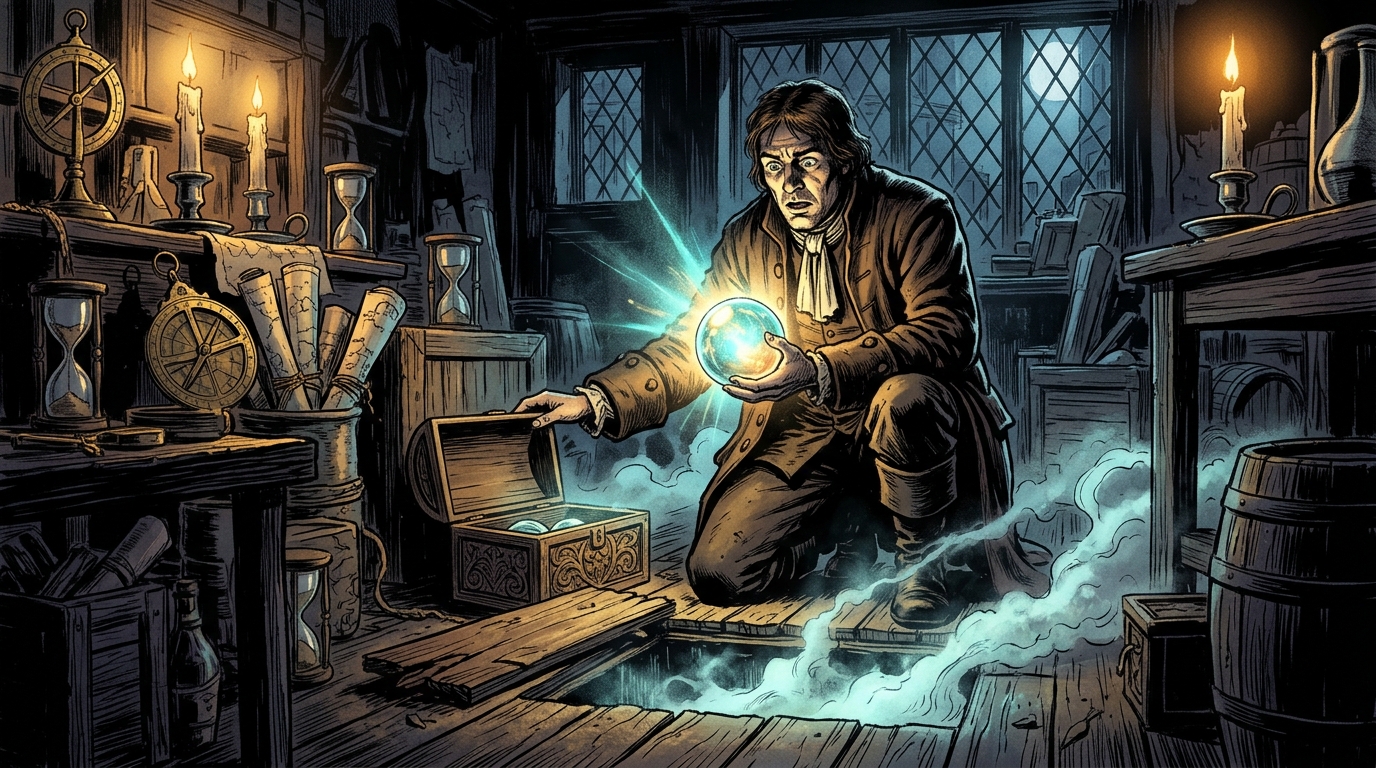
Whenever the column halted beside a stream to drink or bind wounds, Peck sat apart under the drizzling oaks and drew the H6 secretly from his waistcoat pocket.
Now that the initial terror of his escape from Red Lion Square had subsided into a dull ache of hunger and homesickness, the lessons of his five months at John Harrison’s workbench came back to him. He examined the three knurled brass wheels set into the right-hand side of the case. Each wheel was marked with fine divisions, and through a tiny crescent aperture on the back plate he could see a differential gear train linking the wheels to the gold jaws gripping the crystal inside the glass bulb.
‘One wheel for units, one for tens, one for hundreds,’ Peck murmured to himself, tracing the engravings with a dirty thumbnail. ‘And a lever for before or after.’
When he had twisted the glass bulb in panic in his master’s kitchen, his thumb must have brushed the wheels backward by exactly seven hundred and ten years. If he could only work out the ratio of the teeth and set the dials forward by the same measure, the watch ought to carry him straight back to Red Lion Square in 1776.
By the fourth evening, the footsore survivors straggled across the timber spans of old London Bridge into a city gripped by panic and rumour. Having no coin save a copper farthing from the reign of King George III —which would have got him hanged as a counterfeiter or a warlock had he shown it—Peck slipped into a crowded, smoky alehouse near the fish- wharves at Billingsgate to shelter from the rain and puzzle out the dial settings by the light of the hearth.
Sitting in an alcove beneath a string of dried herrings, Peck laid the watch in his lap and was carefully counting the clicks of the middle brass wheel when a shadow fell across his trestle table. ‘That is a dangerous toy for a boy to be playing with in a public tavern,’ a quiet voice said in heavily accented, halting English.
Peck clapped both hands over the watch and looked up sharply.
Standing beside the bench was a lean, weather-beaten man with skin the colour of dark teak, dressed in a salt-stained woollen jerkin and a fisherman’s cap. Though his face was lined by wind and sun, his dark eyes held an extraordinary, haunted intensity that did not belong to eleventh-century London.
‘I don’t know what you mean, mister,’ Peck said defensively, edging toward the wall. ‘It’s only a brass keepsake.’
The stranger slid onto the bench opposite him and leaned across the scarred oak board. ‘Do not lie to me, lad. I have heard the hum of that stone in my teeth across a dozen lifetimes, though I have never before seen it caged inside a golden clock. My name is Raahi Shah. Give it to me. I have silver and gold enough in my pouch to buy you a ship, a farm, whatever you desire—only hand that thing over before it ruins us both.’
Peck stared at him, thunderstruck. Raahi Shah! He had heard no inkling of the name before, yet here was a man in the year 1066 speaking of the crystal as an old enemy.
‘It isn’t for sale,’ Peck said stubbornly, clutching the H6 against his chest. ‘It belonged to my master, John Harrison, and it’s the only way I have of getting home.’
‘There is no going home once you have rubbed that glass,’ Raahi said, his voice roughening with sudden desperation. ‘Every time you turn it, the thread tangles tighter. If you will not sell it to me, boy, I must take it from you and smash it beneath the river stones!’
Before Peck could rise, Raahi lunged across the narrow table and seized the boy’s wrist with both hands.
‘Let go of me!’ Peck shouted, kicking out under the bench and overturning a bench of earthenware tankards.
They crashed together onto the Rush-strewn floor of the tavern. Half a dozen drunken boatmen roared and stepped back to watch the brawl as Peck and the Indian fisherman rolled among the table legs, each struggling for mastery of the gold watch. Feeling Raahi’s iron fingers prising his thumb from the casing, Peck twisted the upper glass bulb with all his strength to escape—just as Raahi’s palm clamped squarely over the quartz dome beside his own.
The crystal inside did not merely spin; caught between two pairs of hands and knocked violently against the flagstones, the brass coordinate wheels slipped six notches forward.
A blinding sphere of blue-white fire exploded beneath the tavern tables, silencing the drunken shouts in a single thunderclap.
Once again the floor dropped away beneath Peck’s back. Tangled together in the roaring void, boy and fisherman tumbled headlong across six centuries—and crashed down upon hard, sun-warmed cobbles in the middle of a deafening roar.
Peck rolled free, gasping for breath and clutching the H6 to his ribs, expecting to see Norman horsemen or Doctor Maskelyne’s soldiers standing over him.
Instead, a shower of red and white rose-petals rained down upon his head.
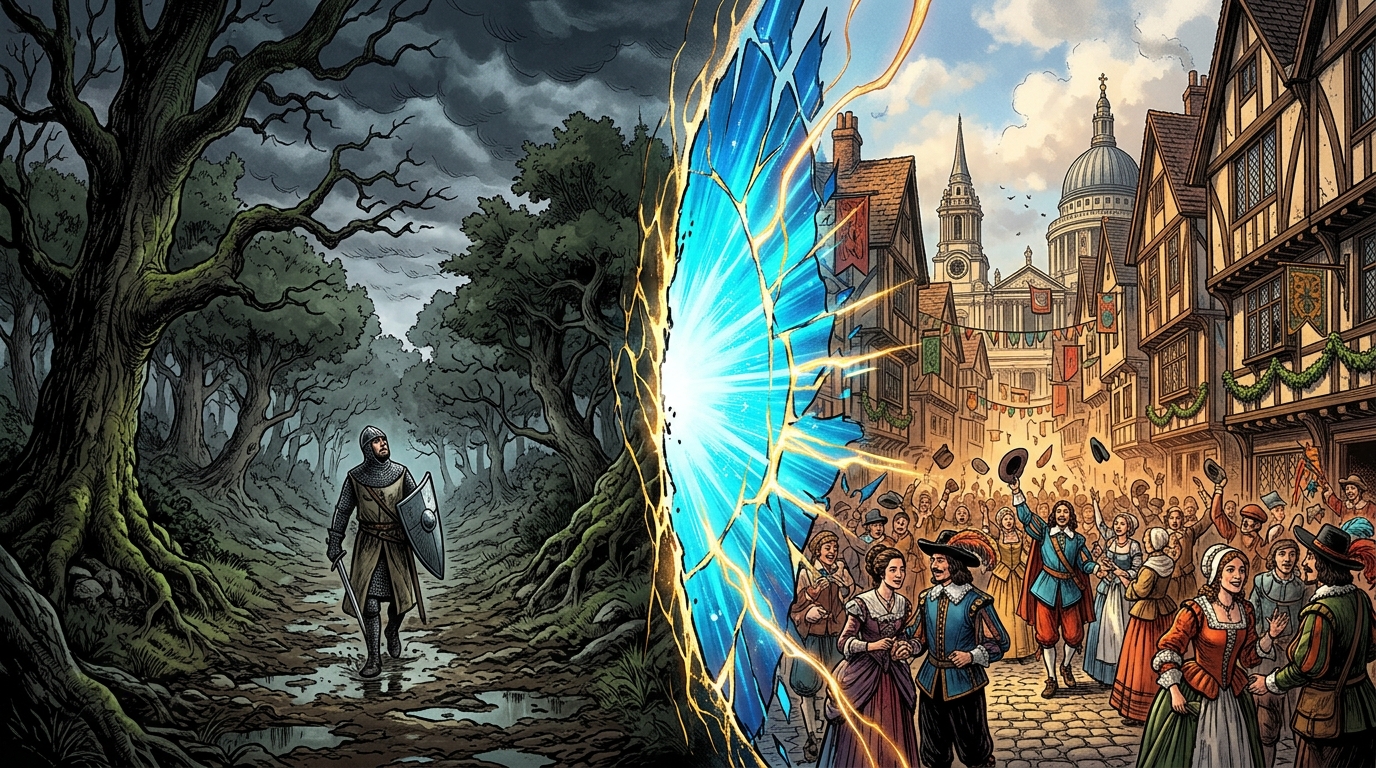
All around them, the narrow street was packed from wall to wall with thousands of cheering citizens waving plumed hats, ribbons, and tankards of sack. Overhead, the timbered gables of Cheapside were hung with rich tapestries and garlands of greenery; every church steeple in London was ringing its bells as though to crack the bronze; and at the end of the thoroughfare, squadrons of cavaliers in buff coats and gleaming breastplates were riding in triumph behind the royal standard.
‘God bless King Charles!’ roared a red-faced vintner, hauling Peck to his feet and clapping him on the shoulder. ‘Off with your cap, lad! The King is come into his own again! Long live Charles the Second!’
It was the twenty-ninth of May 1660—the day of the Great Restoration.
‘Wait—!’ Peck cried, spinning round in the jostling, drunken press to find the dark-skinned fisherman who had fallen through the light beside him.
Ten yards away, near the conduit at the corner of the street, Raahi Shah had staggered to his feet. Yet Raahi was no longer looking for Peck.
The fisherman stood frozen against a draper’s shutter, the blood drained from his teak-dark face, staring across the cheering crowd at a prosperous merchant of middle years who was watching the royal procession from a raised porch opposite.
The merchant was Indian, dressed in a fine coat of English broadcloth and silk, with a gentle-faced wife at his elbow and a ledger tucked beneath his arm.
It was Raahi himself—the older, settled version of Raahi Shah who had already lived through the seventeenth century, established his trading house on the Thames, and was soon to sell a job lot of Malabar goods to a bumbling couple named Browne.
Horrified at the sight of his own double across the cobbles, the younger Raahi turned and plunged into a dark alleyway toward the river, vanishing in the tumult before Peck could fight his way through the revellers.